DSM-5 Informed Behavioral Analysis of Trump’s Post on Mail-in Ballots and Elections

Disclaimer: This analysis is for educational and informational purposes only. It is not a clinical diagnosis, but rather an application of DSM-5-TR criteria to observable public behavior.
Context Today
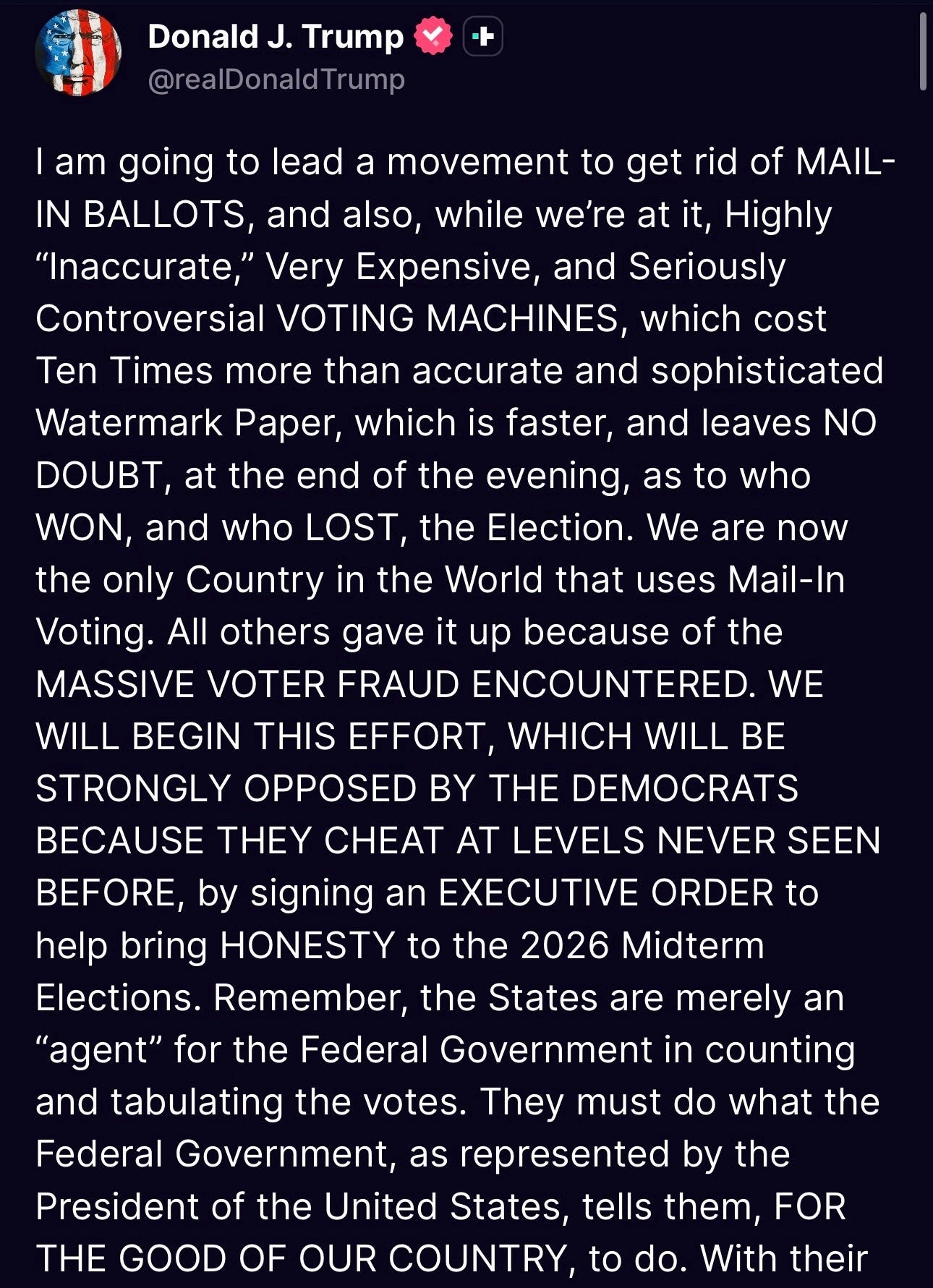

Trump released this post as European leaders and President Zelenskyy gather at the White House, following his humiliating “Alaska Summit” failure, while the U.S. economy teeters into stagflation territory. At the same time, pressure is mounting with the Epstein Files controversy and widening suspicion about the cover-up network. Against this backdrop, Trump’s fixation on mail-in ballots and voting machines signals both projection and preemptive justification for delegitimizing elections he fears losing.
DSM-5 Traits on Display
1. Paranoid Personality Features (Cluster A)
• Suspiciousness & Persecution Ideation: The repeated insistence that Democrats “CHEAT AT LEVELS NEVER SEEN BEFORE” and that voting machines are part of a vast fraud scheme reflects entrenched persecutory ideation.
• Projection: His own history of attempting to subvert elections is displaced onto his opponents, consistent with paranoid projection.
2. Narcissistic Personality Disorder Traits (Cluster B)
• Grandiosity: Phrases like “I am going to lead a movement” and “for the good of our country” elevate himself as the sole savior of democracy.
• Need for Admiration: The performative cadence—ending with “THANK YOU FOR YOUR ATTENTION TO THIS MATTER!!!”—seeks validation.
• Lack of Empathy: Framing election mechanics purely in terms of his personal win/loss outcome, rather than voters’ access or fairness, highlights egocentric orientation.
3. Antisocial Personality Disorder Features
• Deceitfulness: Promoting the “massive voter fraud” narrative despite repeated debunkings.
• Disregard for Rule of Law: Declaring that states are merely “agents” of the federal government and must obey his executive orders reflects contempt for constitutional limits.
• Aggressiveness & Manipulation: Threatening to “fight like hell” mirrors prior incitement patterns.
4. Cognitive & Emotional Dysregulation
• All-or-Nothing Thinking: “Without fair and honest elections, you don’t have even a semblance of a country.”
• Catastrophizing: Casts elections in apocalyptic terms, pairing ballot fraud with “open borders,” “men in women’s sports,” and “woke for everyone.”
• Perseveration: Despite policy crises (foreign relations collapse, economic decline, Epstein fallout), his obsession remains fixed on delegitimizing election systems.
Clinical Summary
Trump’s rhetoric here illustrates a malignant blend of narcissistic grandiosity, paranoid projection, and antisocial disregard for democratic process. Under DSM-5-TR, the convergence of these traits suggests malignant narcissism with paranoid and antisocial dimensions. His language indicates both fear of exposure (Epstein, economic failures, Alaska humiliation) and preemptive justification for rejecting future electoral results.
His post is not merely presidential messaging—it is a psychological defense maneuver under pressure, revealing instability that threatens governance, international credibility, and the rule of law.
Progression of Illness
Compared to even a month or two ago, Trump’s state of mind shows a marked deterioration. Earlier posts, while combative, retained flashes of strategic calculation; now the tone is more desperate, grandiose, and unmoored from reality. His persecutory obsessions are intensifying, with conspiratorial claims amplified in both frequency and severity. The shift from tactical exaggeration to all-consuming paranoia suggests a narrowing cognitive frame: his illness is progressing from malignant narcissism under stress to an increasingly brittle and paranoid defensive posture. This escalation reflects both his psychological decline and his awareness that the walls around him—legal, economic, and geopolitical—are closing in.
Likely Next Phase
On this trajectory, Trump’s mental state points toward escalation rather than retreat. The likelihood is that he will intensify his paranoid claims, broaden his conspiratorial narratives, and lash out unpredictably at perceived enemies, foreign and domestic. The combination of desperation, declining impulse control, and need for constant validation suggests he may resort to increasingly erratic executive actions, incendiary rhetoric, and destabilizing threats to preserve his grip on power. In practical terms, this means we should expect more extreme attacks on institutions, allies, and norms—behavior that mirrors not stability but a leader unraveling under pressure.
Clinical Warning
Based on observed progression over the past two months, Trump’s psychological trajectory points toward escalating paranoia, brittle narcissism, and increasingly erratic decision-making. This pattern is consistent with a leader under acute psychological strain, whose impaired judgment poses risks not only to governance and international stability but to the safety and integrity of U.S. institutions themselves. Expect escalation, destabilization, and authoritarian maneuvers as his defenses unravel.

I’ve been saying this for years! Thank you so much. I genuinely repost DMSV Personality Disorders, and most people don’t understand. Kudos on the article!
Read this and study it closely.