WAR IS NOT EMINENT

But it might be imminent — if Pete Hegseth keeps poking the dragon.
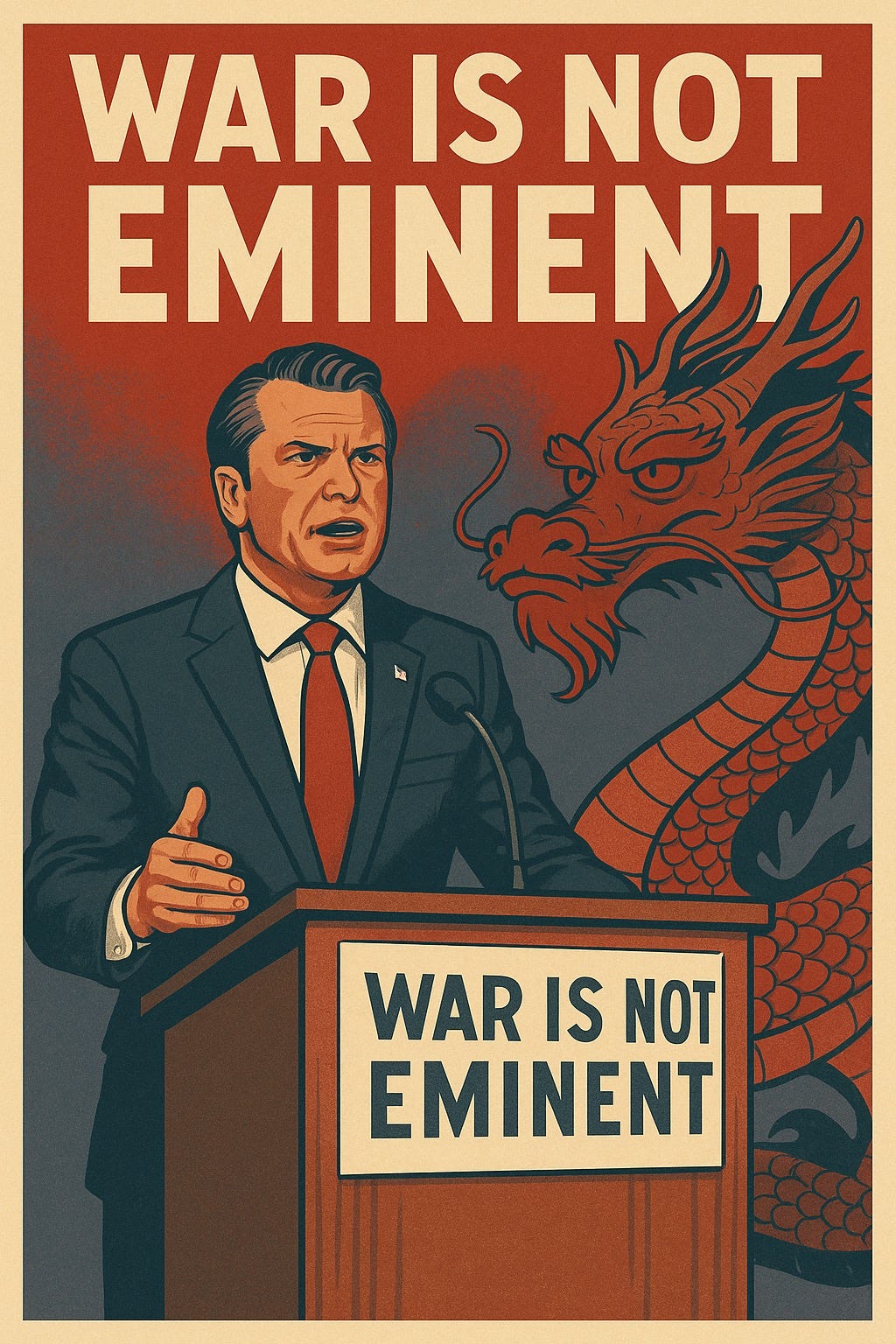
Pete Hegseth made headlines this week by warning the world that China’s military threat “could be eminent.” Not imminent — the correct word — but eminent, as in prestigious. A linguistic flub? Sure. But one that accidentally captured the tragic truth of how U.S. power is being handled: with swagger, not sense.
And yet the slip-up barely scratches the surface of what’s wrong.
Because war is not imminent.
China doesn’t want war with the United States.
And the United States doesn’t want war with China.
So why is Pete revving the engines?
Simple.
The tariffs didn’t work.
The crackdown on Chinese student visas didn’t work.
The “tough guy” trade talk fell flat.
So now it’s time to poke the dragon — not because there’s a real threat, but because someone in the cowboy hat thinks performance equals power.
Pete’s job is to achieve peace through strength.
Instead, we’ve handed a monkey a machine gun — no offense to monkeys.
There used to be a saying: “Speak softly and carry a big stick.”
It’s entirely possible to project strength without provoking war.
But Pete Hegseth does the opposite.
He shouts into microphones at global summits.
I don’t speak Chinese, but I could tell the Chinese representative was furious the moment Hegseth opened his mouth.
He delivers Pentagon policy with the tone of a Saturday morning Fox host.
He acts like a cowboy who’s been rode hard and hung up wet — loud, worn out, and still swinging.
This is not strength. It’s insecurity dressed as theater.
And the theater is dangerous.
China has nukes. So do we. The margin for error is thin, and diplomacy is already fraying. In this context, every word matters. Every gesture matters. And every clown with a podium matters a lot more than he should.
War isn’t eminent.
It’s not even likely — unless someone forces it.
And if Pete Hegseth keeps confusing noise for strategy,
we may all learn the difference between a warning and a warhead.