
Trump’s Math Problem: When 1,000% Becomes Just Another Lie

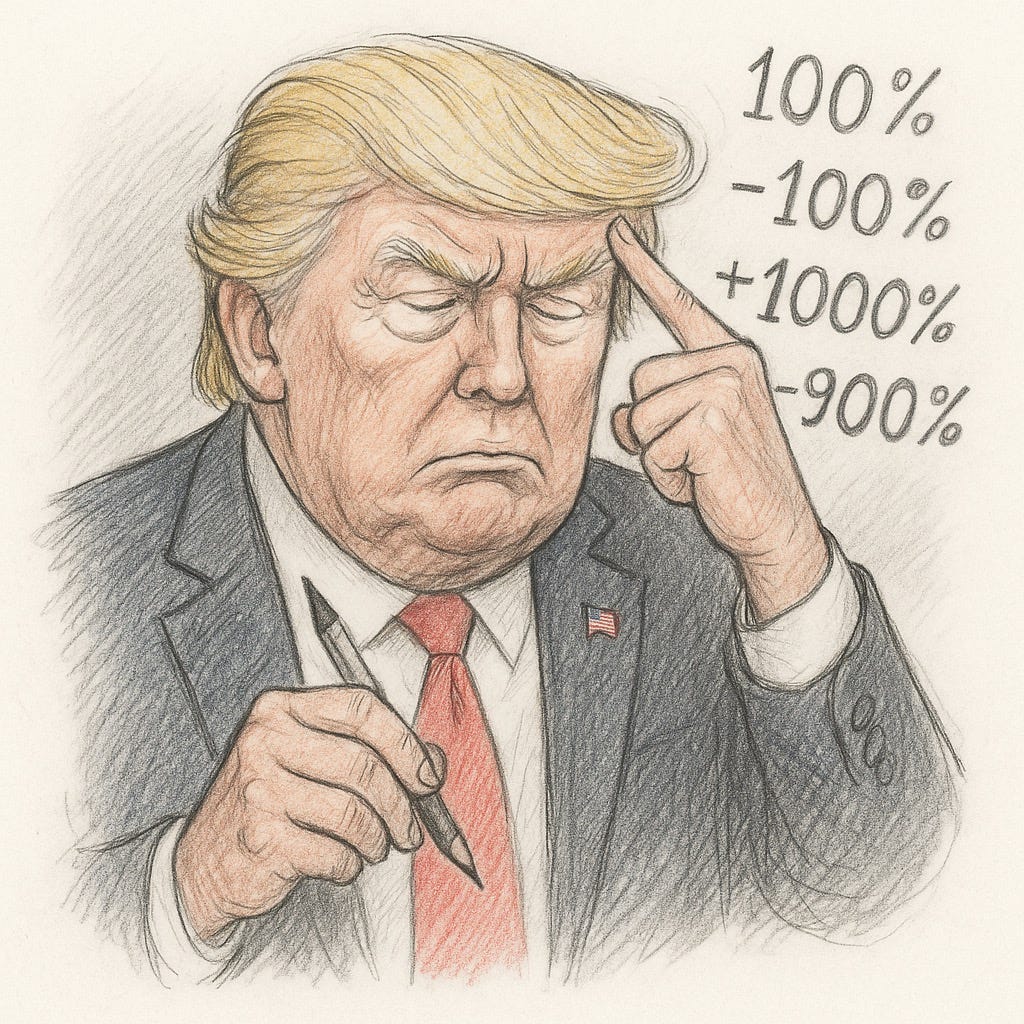
Trump’s percentage blunders come down to a mix of ignorance, rhetoric, and psychology:
1. Basic Math Confusion
Percentages are relative by definition. You can’t reduce something by more than 100%—that would mean you’ve driven the price below zero and are now paying people to take the product. When Trump says “900% reduction” or “1,000% cheaper,” he’s misusing the math. What he seems to mean is “much lower” or “a huge drop,” but he inflates the numbers without understanding the limits.
Important distinction: Percentages above 100% are real in cases of increase (e.g., doubling sales = 100% increase, tripling = 200% increase). But they don’t work for decrease. A price can’t drop more than 100% — at that point, the item would be free. That’s why his claims sound mathematically absurd.
2. Rhetorical Exaggeration
Trump’s communication style thrives on superlatives: “the biggest,” “the best,” “the most ever.” Percentages become another prop for that same exaggeration. The actual numbers don’t matter to him—what matters is the impression of dominance and control. His audience often isn’t fact-checking the math; they’re responding to the emotional weight of “bigger is better.”
3. Psychological Blind Spot
Trump doesn’t process numbers in a technical sense—he processes them as status signals. A thousand percent sounds powerful, so he says it. His worldview has always been about branding and perception, not precision. Because he equates being corrected with being diminished, he doubles down rather than admitting error.
4. Why He Thinks It’s Okay
In his rallies and press gaggles, precision isn’t rewarded—entertainment value is. He gets applause for big, impossible promises, not for accurate arithmetic. In that environment, saying “prices went down 9%” sounds weak, while “1,000%” sounds epic. He believes his audience will take away the feeling, not the fact.
5. Why He Doesn’t See He Looks Foolish
From Trump’s perspective, applause equals validation. If the crowd cheers, it means he’s right. Add in his lifelong habit of surrounding himself with loyalists who don’t challenge him, and he has no feedback loop that says, “You look like an idiot.” Instead, he thinks he looks like a winner, even as people outside the bubble hear nonsense.
Real-World Examples of Trump’s Number Games
If the percentage blunders sound familiar, it’s because they echo the very fraud he was found liable for in New York: inflating his wealth by inventing numbers out of thin air.
• Trump Tower apartment: Claimed his penthouse was 30,000 sq. ft. when it was really about 11,000 sq. ft. — an exaggeration of nearly 200%.
• Mar-a-Lago: Valued at $739 million, even though appraisers put it closer to $18–27 million for club use. That’s a 2,500% exaggeration.
• Seven Springs estate: He claimed it was worth $291 millionbased on imaginary development potential. Appraisers valued it at $56 million — a 420% inflation.
• Cash claims: Bragged about “billions in cash on hand,” when evidence showed he inflated liquidity by 500% or more compared to bank records.
It’s all the same pattern: whether it’s square footage, property values, or “1,000% cheaper,” Trump uses math as a branding tool, not a measurement.
This is a one-woman newsroom — no ads, no sponsors, no safety net. If my work helps you see more clearly, toss a coin in the jukebox and keep the music playing. Comments, restacks, and free subscriptions keep this community alive too — thank you.
— Joyce.
Thanks for pointing out that he is not “too big” in the brains department. He demonstrated his illiteracy when he was in England praising the king (the look on the king’s face was absolutely priceless!) and now he demonstrates his inability for simple math. I’m not going to throw stones very hard because I was terrible at math, but at least I don’t pretend to be. What a president….ick!
We all know by now that he is a pathological liar.