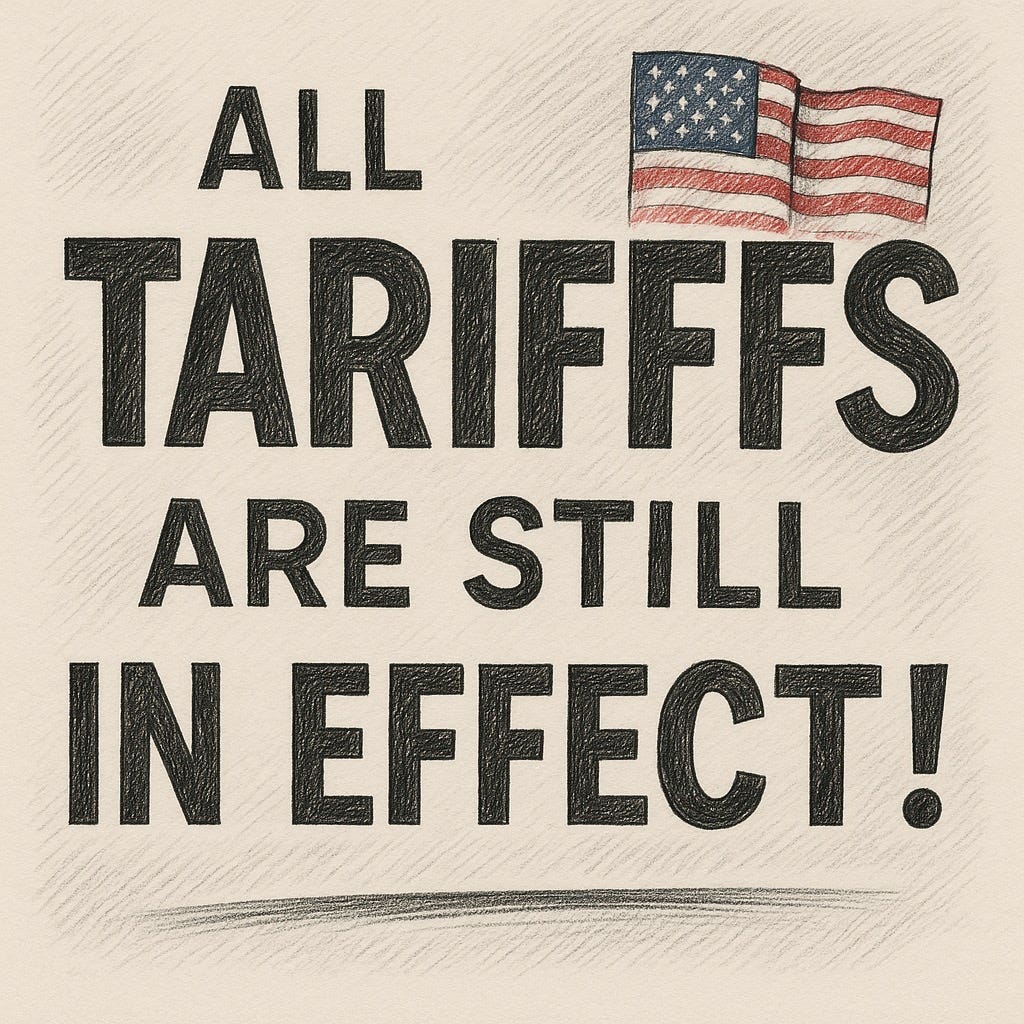
Tariffs, Delusion, and Decline: Trump’s Post Through the DSM-5 Lens

Disclaimer: This analysis is for educational and informational purposes only. It applies psychological frameworks from the DSM-5-TR to public behavior, not to diagnose any individual. It highlights observable patterns in language and conduct that align with recognized criteria.
Context and Stressors This Week
1. Legal Blow on Tariffs
A federal appeals court ruled that Trump abused emergency powers in his trade war. Though the tariffs remain during appeal, the decision is a significant legal and political setback.
2. Mounting Legal and RICO Pressures
Trump continues to face fallout from investigations into the Epstein files and accusations of cover-ups involving close allies. These unresolved threats feed his paranoia and defensive posturing.
3. Holiday Weekend Stage
Labor Day weekend provides a symbolic backdrop. Trump seizes on patriotic framing (“MADE IN AMERICA,” “Workers,” “Powerful Again”), revealing his fixation on staging moments of strength precisely when reality undermines him. The holiday, meant to honor collective worker solidarity, is recast as a stage for personal glorification.
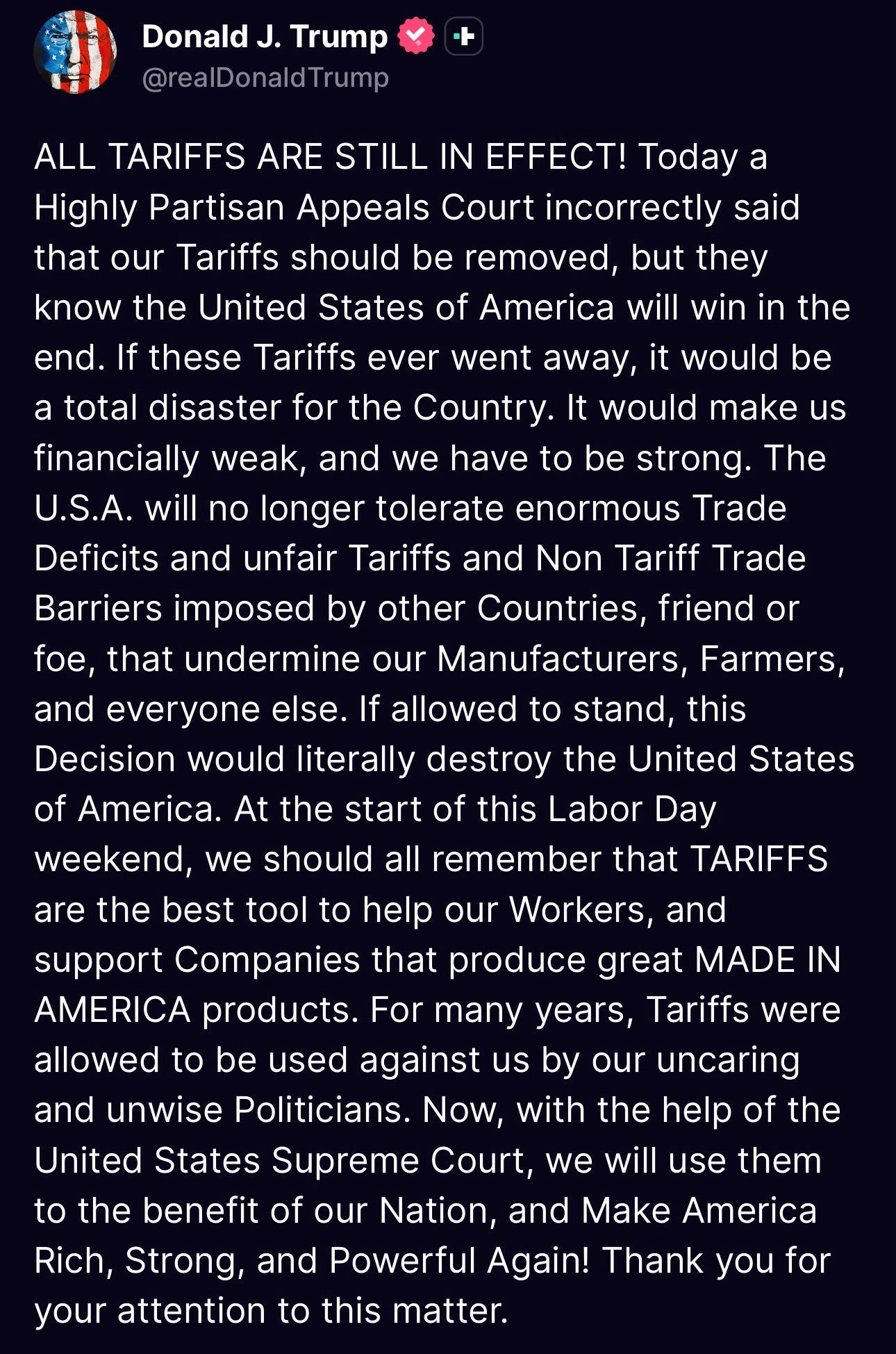
DSM-5 Traits Observed
1. Paranoid Ideation (Delusional Disorder, Persecutory Type)
• Casts a neutral appeals court as “Highly Partisan.”
• Frames the ruling as an existential threat (“literally destroy the United States”).
• Suggests foreign and domestic enemies are conspiring simultaneously against him and the country.
2. Grandiosity (Narcissistic Personality Disorder)
• Claims only his tariffs can “Make America Rich, Strong, and Powerful Again.”
• Positions himself as the singular protector of American strength.
• Disregards legitimate checks and balances, replacing them with his self-image as savior.
3. Disorganized and Catastrophic Thinking (Neurocognitive Decline / Dementia Indicators)
• Language spirals into repetitive exaggeration (“total disaster,” “literally destroy”).
• Concepts are conflated: tariffs both defend America and, if challenged, will end it entirely.
• Increasing reliance on simplistic binaries—strong/weak, win/lose—typical of cognitive rigidity in dementia.
4. Perseveration (Dementia Symptomatology)
• Obsessive repetition of “TARIFFS” in capital letters.
• Difficulty generating new arguments; instead, he loops the same talking points.
• Reflects declining executive functioning and flexibility in thought.
5. Projection (Defense Mechanism)
• Labels others as “uncaring and unwise politicians” while he himself undermines institutions.
• Calls the appeals court “Highly Partisan” while openly depending on the Supreme Court to intervene on his behalf.
• A hallmark of narcissistic and paranoid pathology: attributing one’s own flaws and corrupt strategies to others.
Clinical Frame
Trump’s fixation on tariffs—despite a decisive legal ruling—reveals an entrenched pattern of paranoid grandiosity coupled with cognitive decline. His stress response amplifies symptoms: repetition, catastrophizing, binary thinking, and persecutory projections.
A baseline comparison is instructive: in 2018–2019, his tariff rhetoric was aggressive but structured. Today, it is increasingly incoherent, repetitive, and apocalyptic, showing the trajectory of decline.
His invocation of the Supreme Court highlights how he leans on institutional cover, not only to maintain power but to shield his enterprise — dovetailing with the broader RICO protection web that has insulated him from accountability.
For the public, the danger lies not only in the economic consequences of reckless tariffs but in the leader’s deteriorating ability to process setbacks without descending into delusional rage.
EPILOGUE: This week’s post underscores the fragility of Trump’s psychological state under pressure. Each defeat becomes a cosmic struggle. Each ruling becomes a conspiracy. Each holiday becomes a stage. What we are witnessing is not just political spin—it is the clinical unravelling of an aging strongman.